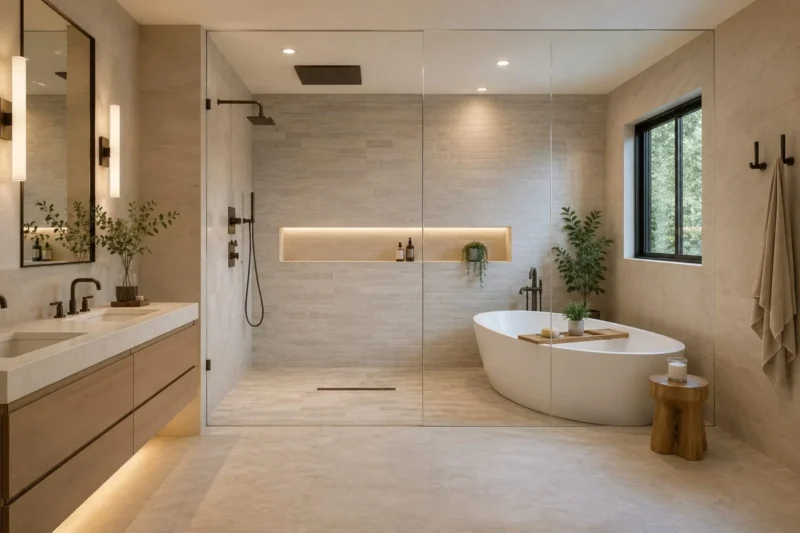
How Much Does It Cost to Add a Bathroom?
Adding a bathroom costs $5,000 to $150,000, with most homeowners paying $10,000 to $35,000 for a straightforward half or full bath. A powder room converted from a closet runs $5,000-$25,000. A full bath addition runs $20,000-$50,000+. A primary suite addition with a new bedroom and bath can hit $75,000-$150,000 or more.
Quick-Answer: Bathroom Addition Cost by Type
| Bathroom Type | National Average | Low End | High End |
|---|---|---|---|
| Half bath / powder room | $12,000 | $5,000 | $25,000 |
| Full bath (toilet, sink, tub or shower) | $30,000 | $20,000 | $50,000 |
| Primary suite addition (bedroom + full bath) | $100,000 | $75,000 | $150,000+ |
These are national averages pulled from contractor-reported project data — your number moves a lot based on one thing more than any other: how far the new bathroom sits from your existing plumbing stack. I’ll walk through why below.
What Actually Drives the Cost of a Bathroom Addition
I’ve bid hundreds of these jobs, and the estimate almost never comes down to “how big is the room.” It comes down to five line items. Here’s how they typically split up a $20,000-$35,000 full bath addition.
Plumbing (Often the Single Biggest Line Item)
Plumbing and electrical rough-in can eat 10-20% of your budget when the new bathroom sits near an existing wet wall — and as much as 30% when it doesn’t, according to 2026 contractor-reported cost data. Plumbers charge $45-$200 an hour depending on your market. Every extra foot of pipe run back to the main stack, every floor you cross, and every time a line has to snake under a slab adds real labor hours, not just materials cost.
This is the same math that makes an emergency plumbing repair expensive fast — if you’re already dealing with old galvanized pipe or a water heater on its last legs, it’s worth reading our guide on what to do if your water heater is leaking before you commit to a bathroom location, since your plumber may recommend addressing both at once to avoid opening the same wall twice.
Electrical
New bathrooms need a dedicated GFCI circuit, vent fan wiring, and often new lighting. Electricians run $50-$100 an hour. Budget $500-$1,500 for a straightforward run, more if your panel needs a new circuit breaker slot or an upgrade.
Framing & Foundation
Converting existing space (a closet, a corner of a bedroom, part of a garage) skips this cost almost entirely — you’re just building interior walls. A true addition that extends your home’s footprint requires new foundation, framing, roofing, siding, and exterior finishing, which is the main reason additions run $400-$600 per square foot compared to $200-$300 per square foot for interior conversions.
Tile, Fixtures & Ventilation
Materials — tile, vanity, toilet, tub or shower unit, fixtures, mirrors, lighting — typically make up 40-60% of total cost, and homeowners consistently report tile and fixtures as the single biggest driver of final price. A tile shower alone can run $8,000-$10,000 installed even when the tile itself only cost $2,000, because shower tile work is labor-intensive and unforgiving of mistakes. Proper exhaust ventilation also matters more than people think — a bathroom fan needs to vent to the exterior, not just into an attic, both for code and for mold prevention. If you’re weighing ventilation and HVAC tie-ins for the new room, our guide on central AC not blowing air covers how bathroom exhaust and your home’s HVAC system interact.
Labor & Permits
Labor overall — plumbing, electrical, framing, tile setting, general carpentry — typically accounts for 40-60% of the total project cost. Permit fees vary widely by city and county, generally landing between a few hundred dollars and $1,500-$2,000 depending on scope; a full addition with new plumbing and electrical almost always needs a permit, and skipping one can cause problems when you sell the house.
Cost by Bathroom Type
Half bath (powder room): Just a toilet and sink, no tub or shower, which keeps plumbing simple. Converting a closet or under-stair space into a powder room costs $5,000-$7,500 for a small 25-square-foot room near existing plumbing. A half bath addition that requires new exterior walls runs closer to $15,000-$25,000.
Full bath: Adding a tub or shower brings in more waterproofing, more tile, and a bigger drain line. Expect $20,000-$50,000, with the low end for a converted space near existing plumbing and the high end for a new addition with mid-to-high-end finishes.
Primary suite addition: A new bedroom with an attached full or three-quarter bath is its own construction project — new foundation, framing, roofing, HVAC extension, and finishes across two rooms. These run $75,000-$150,000 on average nationally, and can exceed $250,000 in high-cost markets or with luxury finishes, per 2026 national contractor cost surveys.
Cheapest Way to Add a Bathroom
The cheapest bathroom addition, by a wide margin, is converting existing interior space that already sits close to a plumbing wet wall. Think: a closet next to an existing bathroom, unused space under a staircase, or part of a laundry room. You skip foundation work, roofing, and exterior finishing entirely, and you can often tie into existing supply and drain lines instead of running new ones.
Converting a closet into a bathroom typically runs $5,000-$20,000 depending on size and how far it sits from existing plumbing, with a small 25-30 square foot closet-to-powder-room conversion landing around $6,000-$7,500 on the low end. Compare that to a ground-up addition, which runs $20,000-$75,000+ once you add foundation, framing, and roofline work.
Three more ways to hold costs down without gutting the plan:
- Stay close to existing plumbing. Basements and rooms that back up to an existing bathroom or kitchen wall are the cheapest locations because the drain, vent, and supply lines are already close by.
- Choose a three-quarter bath over a full bath. A shower stall instead of a tub-shower combo saves on both the fixture and the framing needed to support a tub.
- Skip the addition if you can convert. Every square foot you don’t have to build new walls, roof, and foundation for saves roughly $200-$350 per square foot compared to new construction.
Get Free Quotes From Local Licensed Remodeling Contractors
Tell us about your project and we’ll match you with vetted, licensed contractors in your area who bid bathroom additions regularly. No obligation, no cost to compare quotes.
By submitting this form, you agree to share your information with KennewHouse and up to four matched local remodeling contractors, who may contact you by phone, text, or email — including by automated dialer — about your project. Consent is not a condition of purchase. Message and data rates may apply.
Does Adding a Bathroom Increase Home Value?
Yes, but not dollar-for-dollar. According to the 2025 Cost vs. Value Report from Remodeling Magazine, a midrange bathroom addition recoups roughly 53% of its cost at resale, while an upscale addition recoups closer to 36% (Remodeling Magazine, 2025 Cost vs. Value Report). That’s lower than remodeling an existing bathroom, where midrange remodels currently recoup around 73-80% of cost — the highest that figure has been in nearly two decades.
Where an addition pulls ahead of a remodel is need. If your house has one bathroom and four bedrooms, adding a second bathroom does more for resale marketability than the recoup percentage alone suggests, because it takes the house off buyers’ “pass” list entirely. Separately, research on three-quarter bath additions (toilet, sink, shower) found they can increase home value by roughly 10-11% in some markets. The resale math favors additions most when they fix a genuine shortage, not when they’re adding a fourth bathroom to a house that already has three.
How Long Does a Bathroom Addition Take?
Plan on 6-12 weeks total from design through completion for a straightforward half or full bath addition, including 4-5 weeks of design, permitting, and material selection before a single wall gets opened. Actual construction typically runs 2-3 months once crews start.
Permitting is the wildcard. In some jurisdictions it takes two weeks; in others, especially if you’re adding square footage to your home’s footprint, it can take a couple of months before you get approval to break ground. A primary suite addition with new foundation work runs longer — often 3-6 months start to finish, depending on weather, inspection scheduling, and how easy it is to get materials.
How to Save Money on a Bathroom Addition
- Put it near existing plumbing. This is the single biggest lever you control. A bathroom sharing a wall with the kitchen or an existing bath saves thousands in pipe runs alone.
- Convert instead of build new. A closet or underused room conversion at $200-$300/sq ft beats new construction at $400-$600/sq ft every time.
- Pick mid-grade fixtures. Porcelain tile instead of natural stone, a standard tub-shower unit instead of a custom tile shower pan, a stock vanity instead of custom cabinetry — these choices alone can shave 20-30% off materials cost without looking cheap.
- Get three quotes minimum. Bathroom addition bids vary more than almost any other remodeling category because so much depends on the contractor’s read of your plumbing access. Don’t take the first number.
- Bundle it with other work. If you’re already opening a wall for an addition, it’s often cheaper to also address adjacent electrical or plumbing issues than to pay a separate mobilization fee later.
How to Choose a Contractor for a Bathroom Addition
Verify the contractor’s state license and general liability/workers’ comp insurance before you sign anything — ask for the certificate directly, don’t just take their word for it. Confirm they’re pulling the permit themselves; a licensed contractor pulls their own permits as a matter of course. Ask for at least three references from bathroom addition jobs specifically, not general remodeling, since plumbing rough-in work is its own skill set.
Membership in a trade group like the National Association of the Remodeling Industry (NARI) is a decent signal — members agree to a code of ethics and the directory is searchable by ZIP code (NARI, Choosing the Right Contractor). It’s not a guarantee, but it’s a reasonable starting filter when you’re vetting strangers to open up your walls.
Red Flags of a Scam Bathroom Addition Quote
A quote that comes in dramatically lower than every other bid is the number one warning sign — it usually means the contractor plans to make it up with change orders once demo starts. Other red flags worth walking away from:
- They ask for full payment, or a very large deposit, upfront before any work starts.
- They pressure you to sign “today only” for a discount.
- They only give verbal estimates and won’t put a detailed, line-itemized scope in writing.
- They tell you to pull your own permit — this often means they aren’t actually licensed to pull one themselves.
- They ask for payment by cash, gift card, or wire transfer instead of a traceable method.
The Federal Trade Commission’s consumer guidance covers this in more detail and is worth a read before you sign a contract for a project this size (FTC Consumer Advice, How to Avoid a Home Improvement Scam).
Financing Options for a Bathroom Addition
Most homeowners finance a bathroom addition one of a few ways:
- HELOC (home equity line of credit): Fastest to close, usually 1-3 weeks, and flexible if your project scope shifts mid-build — you only draw what you need.
- Home equity loan: A lump sum against your home’s equity, generally capped around 80% loan-to-value after the cash-out, with a fixed rate.
- Cash-out refinance: Rolls the project cost into a new first mortgage — makes sense mainly if current rates are favorable compared to your existing mortgage.
- FHA 203(k) loan: Combines a home purchase or refinance with renovation costs in a single government-backed loan; the Limited 203(k) caps renovation costs at $35,000, while the Standard 203(k) has no cap (HUD, 203(k) Consumer Fact Sheet).
- Personal loan: No home equity required, faster approval, but generally higher interest rates than home-secured options.
People Also Ask
How much does it cost to add a half bath?
A half bath (toilet and sink, no shower) typically costs $5,000 to $25,000. The low end applies to converting an existing closet or hallway space near existing plumbing; the high end applies to a new addition requiring exterior walls, foundation work, and new plumbing runs. A small 25-square-foot conversion near a wet wall often lands around $5,000-$7,500.
Does adding a bathroom increase home value?
Yes. A midrange bathroom addition recoups roughly 53% of its cost at resale, according to the 2025 Cost vs. Value Report, while an upscale addition recoups closer to 36%. The value boost is highest when the addition fixes a real shortage — for example, going from one bathroom to two in a house with several bedrooms — rather than adding a bathroom the house didn’t really need.
How long does it take to add a bathroom?
Most bathroom additions take 6-12 weeks from design through completion, including 4-5 weeks of planning and permitting before construction starts. Actual build time typically runs 2-3 months. Permitting timelines and how easy the plumbing tie-in is are the two biggest factors affecting your actual schedule.
What is the cheapest way to add a bathroom to a house?
The cheapest way is converting existing interior space — a closet, part of a laundry room, or unused space under a staircase — that sits close to existing plumbing. This costs $200-$300 per square foot versus $400-$600 per square foot for a new addition that requires foundation, framing, and exterior work. Staying close to your home’s existing wet wall is the single biggest cost saver.
How much does it cost to add plumbing for a new bathroom?
Plumbing rough-in alone typically runs $1,500-$4,000 for a bathroom close to existing lines, but can climb toward 20-30% of your total project budget if the new bathroom sits far from your home’s main stack. Plumbers charge $45-$200 per hour, and every additional foot of pipe run, floor crossed, or slab penetration adds labor cost.
Do you need a permit to add a bathroom?
Almost always, yes. Any project involving new plumbing, electrical circuits, or structural changes typically requires a building permit, and often separate plumbing and electrical permits. Permit fees generally run a few hundred dollars up to $1,500-$2,000 depending on your city or county and project scope. Skipping a required permit can create problems when you sell the home.
Is it cheaper to add a bathroom in a basement?
Often, yes — if the basement already has rough plumbing stubbed in, which many do near the utility area. Basement bathrooms can cost less than main-floor additions because you’re not touching the roofline or exterior walls. Costs rise if you need to install an upflush or ejector pump system because gravity drainage isn’t available at that depth.
How much does a three-quarter bathroom addition cost?
A three-quarter bath (toilet, sink, and shower — no tub) typically costs $20,000-$45,000 as an addition, generally landing below a full bath with a tub-shower combo because it needs less framing support and a smaller footprint. Converting existing space into a three-quarter bath can bring that down toward $10,000-$20,000 depending on plumbing proximity.
Ready to Get Bathroom Addition Quotes?
Get free quotes from local licensed remodeling contractors in your area. Comparing three quotes is the single best way to avoid overpaying — it takes two minutes to get started.
By submitting this form, you agree to share your information with KennewHouse and up to four matched local remodeling contractors, who may contact you by phone, text, or email — including by automated dialer — about your project. Consent is not a condition of purchase. Message and data rates may apply.